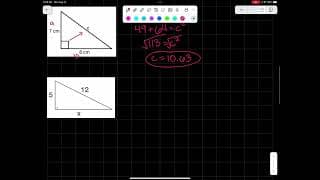
The Pythagorean Theorem
Grade 9th Grade · Math · 50 min
What's Included
Learning Objective
I can use the Pythagorean theorem to find the missing side length of a right triangle.
Warm-Up Video
Math with Mr. J · 7:36
Pythagorean Theorem: Finding the Length of a Missing Leg | Math with Mr. J
Guided Notes
3 key concepts
- 1
The Pythagorean theorem, represented as a² + b² = c², is used to find the missing side length of a right triangle, where 'c' is the hypotenuse and 'a' and 'b' are the legs.
- 2
To find the length of a missing leg, you can plug in the known values into the Pythagorean theorem and isolate the variable representing the missing leg by using inverse operations such as subtraction and finding the square root.
- 3
When the result of the square root is not a perfect square, you can express the answer as a square root or approximate it as a decimal rounded to a certain place value, like the hundredths place.
Practice Questions
11 questions · Multiple choice & Short answer
Exit Ticket
Quick comprehension check
“A right triangle has a hypotenuse of 10 cm and one leg that measures 6 cm. What is the length of the missing leg? Show your work.”
Complete Lesson Package
Get all 3 ready-to-use resources: